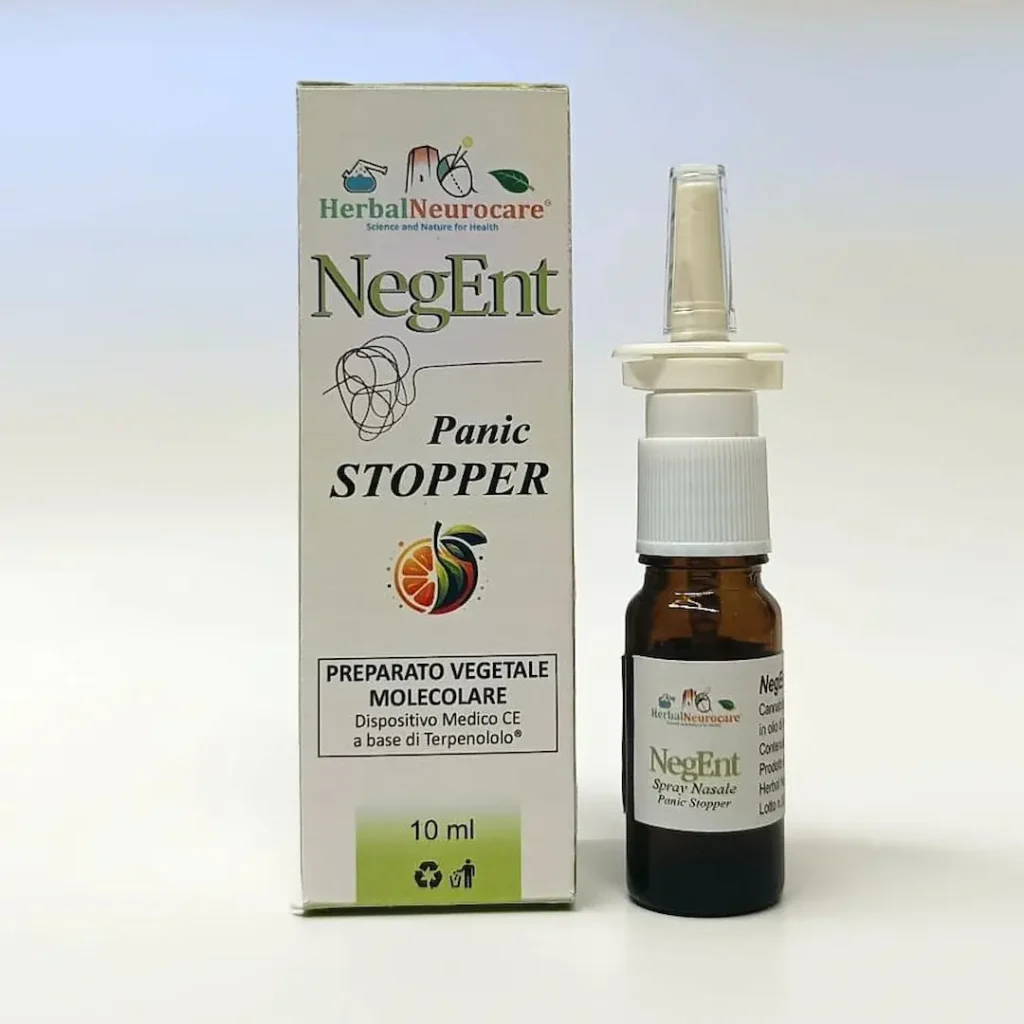
NegEnt Panic Stopper
A panic attack is a specific situation in which there is a sudden onset of intense fear, associated with a feeling of impending doom and, often, death. During the panic episode, the patient perceives marked physical symptoms, such as shortness of breath, palpitations, chest pain or discomfort, nausea, or the urge to vomit.
Since the panic attack is a traumatic experience, it leaves intense and persistent traces in the emotional memories, after each episode, triggering the continuous and nagging worry that another episode could recur at any time. The patient then begins to manifest an anxious state, increasingly present and painful, characterized by the worry of feeling bad and the scenario soon becomes complicated with agoraphobia, in which the subject tries not to move away from his home and from well-known places where he believes he can receive help and support. The subject also develops a marked relational dependence, in the sense that he insistently asks not to be left alone and to always be accompanied and helped by someone he considers reassuring.
Collaboration with the GP and the Psychotherapist
The use of the CE Medical Device, NegEnt Panic Stopper, although it can be self-medicated, should be communicated to the attending physician. In the event that other psychotropic therapies are in progress, the use of NegEnt Panic Stopper can be combined, without any problems, with the ongoing treatment. Since there is not yet adequate scientific literature data, its use in women is not recommended, as a matter of prudence, during pregnancy and breastfeeding.
NegEnt Panic Stopper is only a symptomatic and extemporaneous treatment of panic attacks. The treatment, aimed at healing, through the stable and definitive change of the processes of meaning, requires the application of a cognitive-behavioral psychotherapy protocol, implemented by an expert Psychotherapist.
Bibliographical note
A comprehensive and authoritative scientific article on NegEnt and the treatment of Panic Disorder has been published by Prof. Tullio Scrimali. It is reported in the Bibliography and is available online.
Reference
- Blessing, E. M., Steenkamp, M. M., Manzanares, J., & Marmar, C. R. (2015). Cannabidiol as a potential treatment for anxiety disorders. Neurotherapeutics, 12(4), 825-836.
- Crippa, J. A., Derenusson, G. N., Ferrari, T. B., Wichert-Ana, L., Duran, F. L., Martin-Santos, R., Hallak, J. E. (2011). Neural basis of anxiolytic effects of cannabidiol (CBD) in generalized social anxiety disorder: a preliminary report. Journal of Psychopharmacology, 25(1), 121-130.
- Paudel, K.S, Hammell, D.C., Agu, R.U. Valiveti, S., Stinchcomb, A.I. (2010). Cannabidiol bioavailability after nasal and transdermal application: effect of permeation enhancers. Drug Dev Ind Pharm, Sep; 36 (9): 1088-97. Doi: 10.3109/03639041003657295.
- Polidoro, D., Temmerman R., Devreesse, R et Al. (2022). Pharmacokinetics of Cannabidiol Following Intranasal, Intrarectal, and Oral Administration in Healthy Dogs. Front. Vet. Sci., 07 June.
- Soares, V. P., & Campos, A. C. (2017). Evidences for the anti-panic actions of cannabidiol. Current Neuropharmacology, 15(2), 291–299.
- Scrimali, T. (2023). Cannabidiol, NegEnt and Panic Disorder. Preprints.org, February. doi: https://doi.org/10.20944/preprints202302.0464.v1.
Buy NegEnt Panic Stopper
Click on the button below to purchase NegEnt Panic Stopper and receive it comfortably at your home!